
Save Money on Shipping: Easy Tips for Your Business
Updated
If you offer fast delivery you might not need to pay for express shipping. Box size, service selection and package accuracy are where most shipping spend leaks, and the first of those is the one most operations get wrong.
Why shipping costs matter
Shipping can be one of the largest expenses for an eCommerce business. Without a strategic approach, businesses often end up overpaying. Major carriers like USPS, UPS, and FedEx use cubic weight (or dimensional weight) pricing, which means that the size of the package matters just as much as its weight.
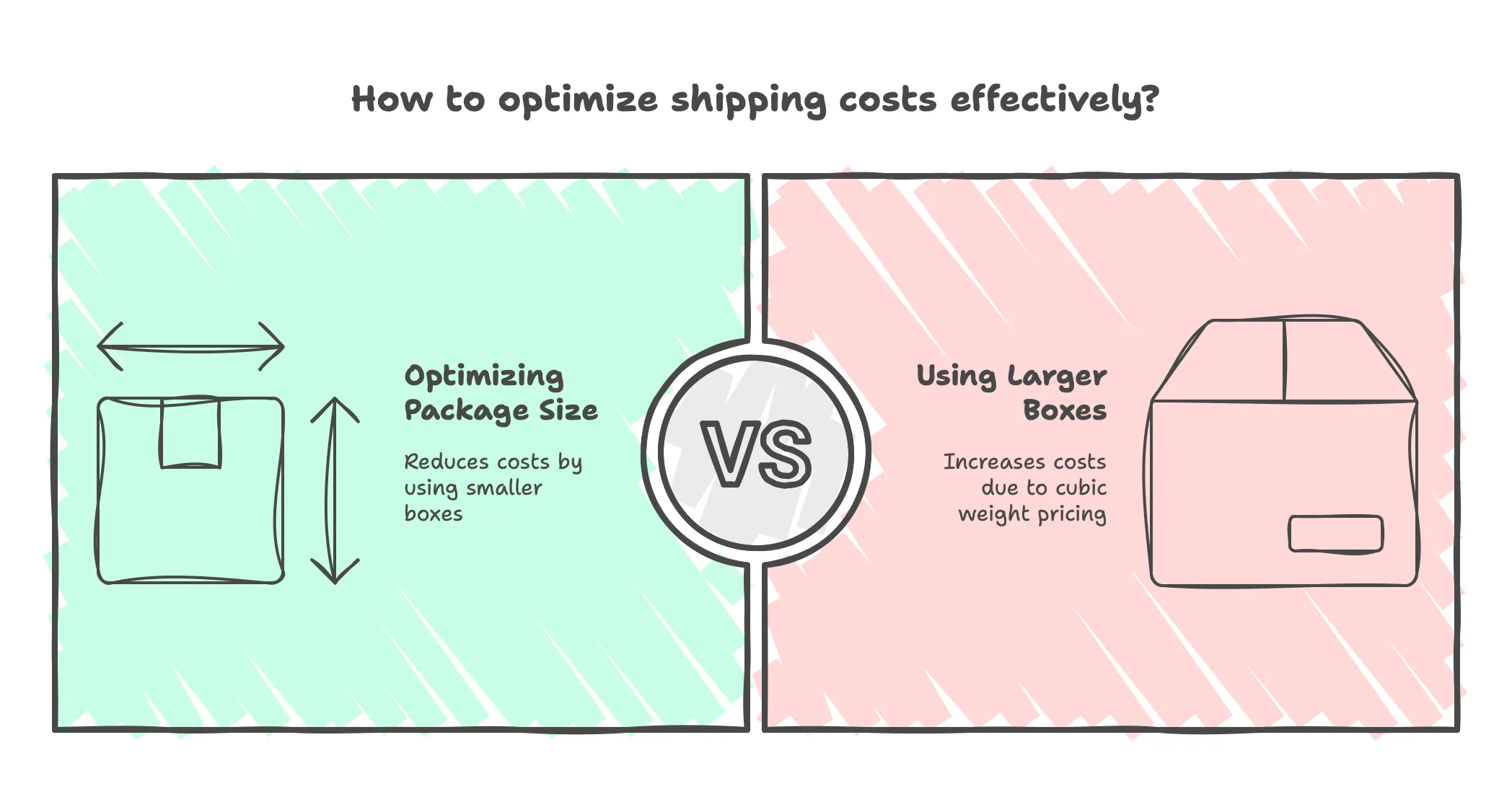
Many businesses overlook this and unknowingly pay significantly more for shipping by using larger-than-necessary boxes. Optimizing your packaging can lead to substantial cost savings.
What is cubic weight?
Cubic weight is a pricing method that charges based on how much space a package occupies, not just its weight. The calculation follows this formula:
(length × width × height) ÷ carrier factorCarriers can use different carrier factors, but 139 is now the standard across the major ones. USPS was the outlier at 166 and moved to 139 in July 2026. The higher of the two weights—actual or cubic—is what determines your shipping cost.
Example Calculation
Consider a package with the following dimensions:
- 20 inches long
- 10 inches wide
- 8 inches tall
- Weighs 5 pounds
Using the formula:
(20 × 10 × 8) ÷ 139 = 11.51 poundsEven though the actual weight is 5 pounds, the carrier will charge you for 11.51 pounds because of the cubic weight pricing model.
How to avoid overpaying
1. Use the Smallest Box Possible
Since carriers charge more for larger packages, choosing the right-sized box can significantly reduce costs. If you offer free or flat-rate shipping, optimizing package size is even more critical.
2. Don’t Try to Trick the Carrier
Some businesses attempt to save money by underreporting package size or weight when purchasing shipping labels. However, carriers weigh and measure every package at distribution centers. If your information is inaccurate, they will issue a chargeback, increasing your costs instead of lowering them.
3. Leverage Special Carrier Services
Certain carrier services offer cost-saving options specifically designed for cubic weight pricing:
- USPS Priority Cubic – Ideal for small, dense packages, as it charges based on cubic dimensions rather than weight.
- FedEx SmartPost and UPS SurePost – Additional options that leverage cubic weight pricing.
If you ship small but heavy items (such as canned beverages), these services can help you save significantly on shipping costs.
Balancing speed and cost
For businesses fulfilling hundreds of orders per day, manually selecting the best package size for every order can be time-consuming. However, avoiding oversized packaging whenever possible can still result in substantial savings. The trade is between the time it takes to get the box right and what the wrong box costs you.
Doing it per order
Choosing the smallest package and then the cheapest service for it is one decision rather than two, and it has to be made against the actual contents of each order.
Where the rate stops being the decision
Knowing how a carrier prices a parcel is useful. The harder question is which parcel to make — because the packing decision sets the dimensional weight and the cubic tier, and the cheapest box changes with the contents, the destination and the rate card.
There are eight situations where that decision has grown past what a rule can express. Most operations are in two or three of them.