
USPS Cubic Pricing: How It Works and What Changed in July 2026
Updated
USPS restructured this on 12 July 2026, and the case for cubic pricing is stronger now than it was a year ago. Not because cubic got cheaper — it didn’t — but because standard Ground Advantage got a great deal more expensive and cubic didn’t move with it.
This page is about cubic pricing itself: what changed, which parcels qualify, and whether it is worth using. If what you want is the two services set against each other — what each costs on the same parcel, and where the crossover falls — that comparison is a separate page.
Everything below is sourced from USPS and the Federal Register directly. Where a figure is computed rather than quoted, it comes from comparing USPS’s own published January 2026 and July 2026 price files.
What changed on 12 July 2026
Four things, all in the final rule.
The maximum longest side went from 18 to 22 inches. This is the one that brings new parcels into scope. The rule’s summary only mentions Ground Advantage Cubic, but the regulatory text amends both products: DMM 223.1.3.1 for Priority Mail Cubic and DMM 283.1.3.1 for Ground Advantage Cubic now both read “the longest dimension may not exceed 22 inches.” If you ruled cubic out because of the 18 inch limit, re-check.
Ground Advantage Cubic soft pack tiers dropped from ten to five. USPS is “reducing the USPS Ground Advantage Cubic Soft Pack pricing tiers from the current ten tiers to five tiers,” bringing them in line with Priority Mail Cubic soft packs. This is soft packs and padded envelopes only. Hard-pack cubic still has ten tiers.
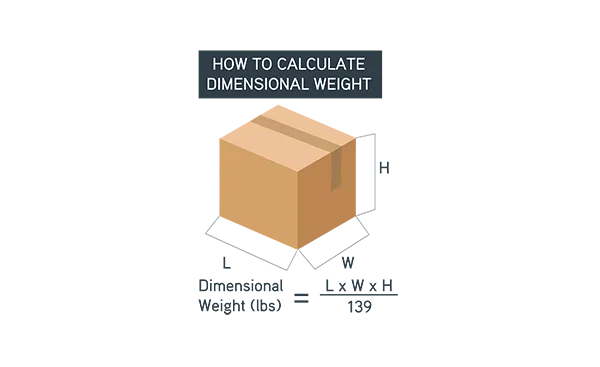
The dimensional weight divisor changed from 166 to 139, effective 12 July 2026. USPS gives its own reason for this one, under the heading Dimensional Weight (DIM) Factor and Piece Dimensions Rounding Changes:
The Postal Service is revising the DIM factor (divisor) and the piece dimensions rounding calculation for retail and commercial Priority Mail Express, Priority Mail, and USPS Ground Advantage, and Parcel Select, for consistency with industry standards. The Postal Service is changing the DIM factor to 139 to determine the dimensional weight in pounds.
“For consistency with industry standards” is USPS’s framing, not mine — this is USPS moving onto a basis it considered already standard rather than inventing a new one. The effect is still an increase: a smaller divisor produces a larger billable weight for the same box, so low-density parcels over a cubic foot got more expensive.
It applies only above one cubic foot — the amended standard reads “if the result exceeds 1,728 cubic inches, divide the result by 139 and round up.” Below that threshold, dimensional weight does not apply at all, which is a large part of why cubic and sub-cubic-foot parcels are worth treating as their own category.
Dimensions now round up. USPS is “revising the rounding requirement for DIM piece dimensions to rounding up the length, width, and height measurements to the nearest whole inch.” A 10.1 inch side bills as 11.
The 2026 price movements, which matter more
Two increases landed before July, and they did not land evenly.
On 18 January 2026, Ground Advantage rose 7.8%. Priority Mail rose 6.6%, Priority Mail Express 5.1%, Parcel Select 6.0%.
On 26 April 2026, USPS added an 8% temporary increase across Priority Mail Express, Priority Mail, Ground Advantage and Parcel Select, running until 17 January 2027, attributed to transportation costs.
Then in July, the commercial ounce tiers went away. USPS revised “the USPS Ground Advantage — Commercial ounce price points (4, 8, 12, and 15.999) to reflect the same price for each ounce price point within a zone.” In practice every sub-one-pound commercial parcel now bills at what used to be the top sub-pound rate. Zone 4, commercial:
| Tier | Jan 2026 | Jul 2026 | Change |
|---|---|---|---|
| 4 oz | $5.30 | $7.46 | +40.8% |
| 8 oz | $5.83 | $7.46 | +28.0% |
| 12 oz | $5.92 | $7.46 | +26.0% |
| 15.999 oz | $6.91 | $7.46 | +8.0% |
Cubic, over the same period, rose 8.0% and nothing more. Comparing every Ground Advantage Cubic cell in the January file against the July file — ten tiers across nine zones — the change runs from 7.93% to 8.06%, averaging exactly 8.00%. That is the April transportation surcharge and no July increase on top.
So a light parcel that used to be cheap on weight got 40% more expensive, while the same parcel priced on volume went up 8%. That gap is the argument for cubic in 2026, and it is worth re-running the comparison even if you checked last year.
What cubic pricing is
Cubic prices a parcel on the space it occupies rather than what it weighs.
Normally you’re charged on the greater of actual weight or dimensional weight — volume divided by 139, above one cubic foot. Under cubic you’re charged purely on volume: length × width × height ÷ 1,728, which gives you cubic feet.
Each hard-pack tier is one tenth of a cubic foot. Priority Mail Cubic runs to 0.5 cubic feet, Ground Advantage Cubic to a full cubic foot. Both cap at 20 pounds and both now cap at 22 inches on the longest side.
Where cubic starts winning
The commonly repeated rule is that savings start around four pounds. That is true for exactly one tier and wrong everywhere else.
The real crossover — the weight above which standard Ground Advantage Commercial costs more than the cubic price for that volume — tracks the tier, and it is the same in every zone:
| Cubic tier | Cubic beats standard above |
|---|---|
| 0.1 cu ft | 1 lb |
| 0.2 cu ft | 2 lb |
| 0.3 cu ft | 3 lb |
| 0.4 cu ft | 4 lb |
| 0.5 cu ft | 5 lb |
| 0.6 cu ft | 6 lb |
| 0.7 cu ft | 7 lb |
| 0.8 cu ft | 8 lb |
| 0.9 cu ft | 9 lb |
| 1.0 cu ft | 11 lb |
Roughly, the crossover in pounds is the tier in tenths of a cubic foot. The practical reading: cubic wins when a parcel is dense for its size, and the smaller the box the less weight it takes to get there.
Two other things count in cubic’s favour. Priority Mail Cubic often buys 1–3 day service for close to what non-cubic Ground Advantage costs. And USPS publishes no residential delivery surcharge, delivery-area surcharge or fuel surcharge — the July 2026 price file contains none. For heavy, small, direct-to-consumer parcels that is a real structural advantage over carriers that do apply them.
The tier is a packing decision, not a rate decision
This is the part most write-ups miss, and it is the reason cubic is harder to capture than it looks.
Cubic tiers are set by the volume of the box you pack into. So the box determines the tier, and the tier determines the price. Rate shopping happens after the box is chosen, which means by the time anything is priced, the tier has already been decided — by whoever picked the carton.
The tier boundaries are close together. A 0.1 cubic foot step is 172.8 cubic inches, which on a mid-sized box is about an inch on one side. With the July rounding change, a side measuring 10.1 inches now bills as 11, and that alone can push a parcel into the next tier up. A packer reaching for the next box up because it is easier to close moves the shipment a tier and adds cost on every order that goes out that way.
Which makes cubic a cartonization problem before it is a rate problem. Getting the cheapest cubic rate means choosing the smallest box the contents actually fit into, per order, and that calculation needs the dimensions of the items rather than an assumption about the order. That is cartonization, and which tier you land in is decided by it.
What it takes to get right
Dimensions have to be accurate. Cubic is priced entirely on measurements, so a wrong number is a wrong price. USPS charges a $3.00 Dimension Noncompliance Fee for parcels over one cubic foot or over 22 inches in length where dimensions are omitted or inaccurate in the manifest. Worth knowing what changed here, because it is widely misreported: the Parcel Dimension Compliance rule is in two phases. From 12 July 2026 accurate dimensions are required in the manifest for all parcels, but assessing the fee against that broader requirement is “deferred until the implementation of phase two,” which is “tentatively scheduled for early 2027.” The narrower fee above has been chargeable throughout.
Adjustments cut both ways. Request a cubic rate with dimensions that don’t match the parcel and USPS adjusts the account after the fact. It is equally possible to buy cubic when standard would have been cheaper, which is the quieter error because nothing flags it.
Check whether your platform is already doing it. Most shipping platforms surface cubic rates automatically where an order qualifies, so you may be using it without having decided to. What determines how much you get out of it is the accuracy of your dimensions and weights, because those decide which tier you land in.
Who it suits
Businesses that fare particularly well from cubic rates are ready-to-drink beverage companies, electronic suppliers, and home supply businesses — anything where the product is dense. If you ship apparel, accessories or other relatively lightweight goods, cubic will not do much for you, and the January and April increases hit you on weight regardless.
One thing to watch
USPS has proposed a temporary holiday increase running 4 October 2026 to 17 January 2027, on Priority Mail Express, Priority Mail, Ground Advantage and Parcel Select. Unlike the April surcharge, the commercial increases are specified by cubic tier, so cubic is included this time. Increases range from $0.40 to $20.80 depending on zone and weight.
It is proposed rather than approved — the release says “Pending favorable review by the PRC, the temporary rates would go into effect” on 4 October. If it lands, the gap between cubic and weight-based pricing narrows over peak. Worth re-checking your own numbers in October rather than assuming the summer arithmetic still holds.
Where the rate stops being the decision
Knowing how a carrier prices a parcel is useful. The harder question is which parcel to make — because the packing decision sets the dimensional weight and the cubic tier, and the cheapest box changes with the contents, the destination and the rate card.
There are eight situations where that decision has grown past what a rule can express. Most operations are in two or three of them.