
Why You Should Ship Smaller Packages
Updated
Carriers bill on the greater of a parcel’s actual weight and its dimensional weight. On anything light for its size, that means the box sets the price rather than the contents — and the box is decided before any rate is fetched, by whoever packs the order or, where a packing rule is on, by a calculation that solves for fit without looking at where the dimensional weight threshold falls.
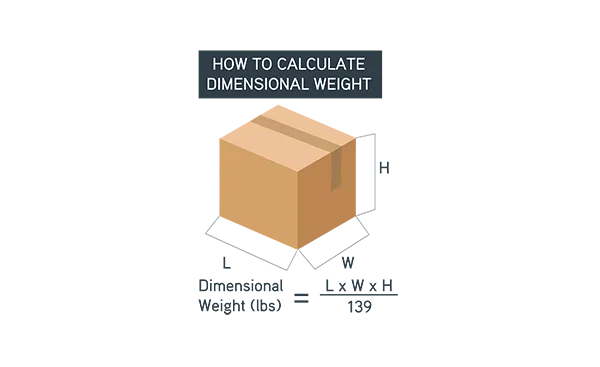
The divisor is 139 across the major carriers. USPS is the one to watch, because it only applies dimensional weight above one cubic foot and only moved to 139 in July 2026 — what changed and what it did to pricing.
What the calculation costs you
Take a 16 × 14 × 10 inch carton. That is 2,240 cubic inches, which divided by 139 gives 16.12, rounded up to a 17 lb billable weight. If what is inside weighs 7 lb, you are paying for ten pounds of air.
Now take two inches off the longest side. A 14 × 14 × 10 carton is 1,960 cubic inches, which is 14.10, rounded up to 15 lb. Two inches on one dimension moved the billable weight by two pounds, on every parcel that ships in that box.
That is the whole argument for smaller packages, and it scales with volume rather than with effort. The box is chosen once and then applied thousands of times.
Two 2026 changes that made it worse
USPS moved its divisor from 166 to 139 on 12 July 2026, in a final rule that gives the reason as consistency with industry standards. A smaller divisor produces a larger billable weight for the same box, so every low-density USPS parcel over a cubic foot got more expensive on the same day.
The same rule also changed how dimensions are measured. USPS now rounds each side up to the nearest whole inch. A side measuring 10.2 inches bills as 11, which turns that first carton into 16 × 14 × 11 — 2,464 cubic inches, 17.73, rounded up to 18 lb. A fifth of an inch of tape and cardboard, measured honestly, costs a pound.
The practical consequence is that a box which was borderline before is probably over the line now, and the parcels most affected are the ones you are least likely to be watching: light contents in a box chosen for convenience.
Where the decision actually gets made
None of this is decided at the rating step. By the time a rate is fetched the box is already packed, so the billable weight is fixed before anything is priced. The saving is available only at the moment somebody chooses a carton.
For a narrow catalogue that ships in two or three standard boxes, this is discipline rather than software — keep the presets current and check periodically that the box chosen was the smallest that fits. It stops being discipline when the right box depends on the combination of items in the order rather than on any one product, which is cartonization, a computation over item dimensions rather than a rule you can write down.
The service half of this
Smaller boxes are one of two reasons the same parcel can cost less. The other is that ground and express services have converged on many domestic lanes, so an express service is often buying a delivery date you were going to get anyway. That is a separate decision with its own caveats — chiefly that a delivery estimate is not a delivery guarantee — and it is covered in why you probably don’t need express shipping services.
Shipments priced on the box
The packing efficiency report shows which of your shipments were priced on the size of the box rather than the weight.