
Your Products Aren't Cubes
Published
Short answer: Most automated packing tools assume every product is a rigid block and try to fill the box as tightly as possible. That breaks in two ways. A plan with no slack only works if your team packs it exactly as drawn, and real products have necks, hollow insides and bags that give. Once a parcel is billed on its actual weight, a tighter box often saves nothing anyway. String’s Pro Automation plans for products as they behave, with room for a real packer to work.
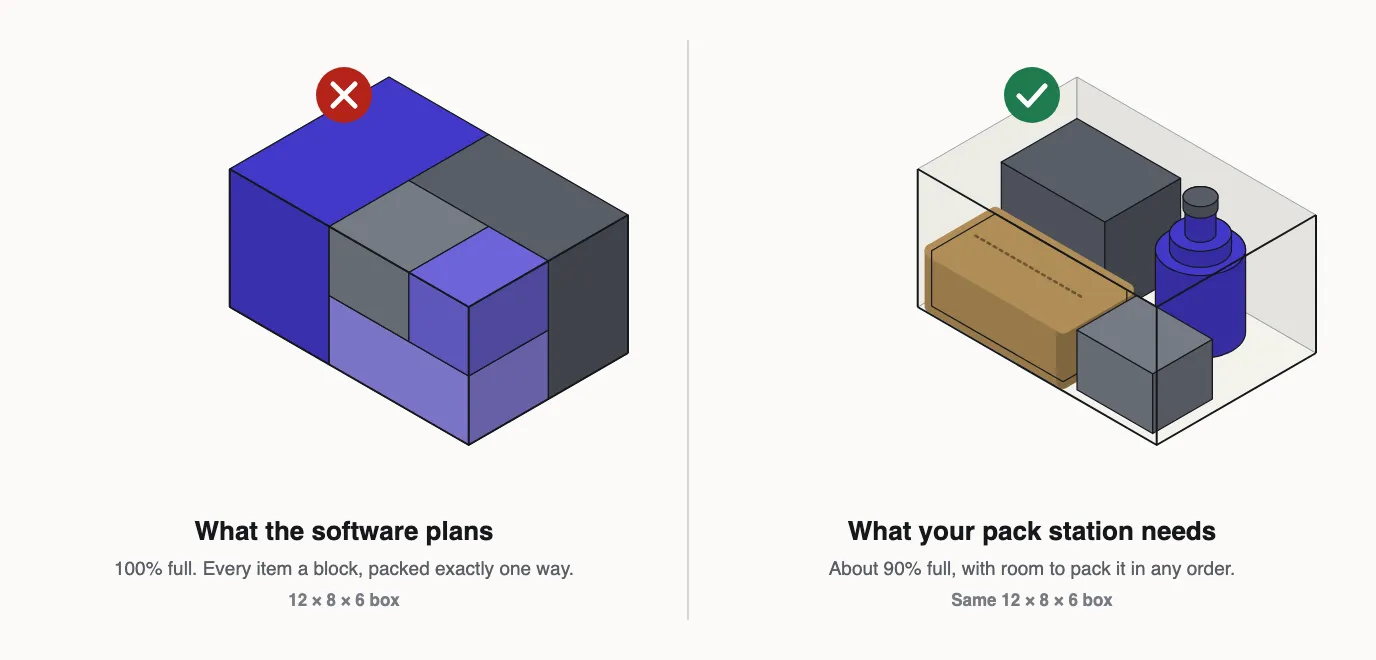
Go look at the website of nearly any automated packing tool. You’ll find the same picture: five colorful blocks fitting perfectly into a box. Maybe with a little label telling you it’s a medium.
It’s a great picture. Nobody at your pack station is getting that result during peak.
Problem 1: A perfect plan is hard to pack
A plan that fills a box to the last inch has exactly one solution. Block C goes on the left, E stands up in front, and D lies on top. Put them in another order and the box doesn’t close.
Your packer doesn’t get a 3D diagram and an afternoon to study it. They get a stack of items and a clock. So they try it, it doesn’t close, and they grab the next size up. Now you’ve got the bigger box anyway, plus the time they spent trying.
That’s why I aim for about 90% full. It leaves enough room to pack the box in whatever order the items come out.
Problem 2: Tighter often doesn’t save anything
Carriers bill on the greater of actual weight and dimensional weight. So a smaller box only saves money while the box is what’s setting the price.
Take that 12 × 8 × 6 box. At a divisor of 139, it has a dimensional weight of 5 lb (576 ÷ 139 = 4.14, rounded up). One size down, a 10 × 8 × 6 comes to 4 lb.
| What’s inside weighs | Billed in 12 × 8 × 6 | Billed in 10 × 8 × 6 | Does the smaller box help? |
|---|---|---|---|
| 3 lb | 5 lb | 4 lb | Yes |
| 7 lb | 7 lb | 7 lb | No |
At 7 lb, you’re paying for weight in both boxes. Solving the harder packing puzzle gets you nothing on the label, and you’ve still made it harder to pack.
The exception is pricing based on the box. On USPS cubic, weight doesn’t set the tier. Those same two boxes land in the 0.4 and 0.3 tiers, whatever is inside them, as long as the parcel is within cubic’s limits. So this has to be worked out with the rate, not assumed. That’s why packing and rating can’t be separated.
Problem 3: Products don’t look like that
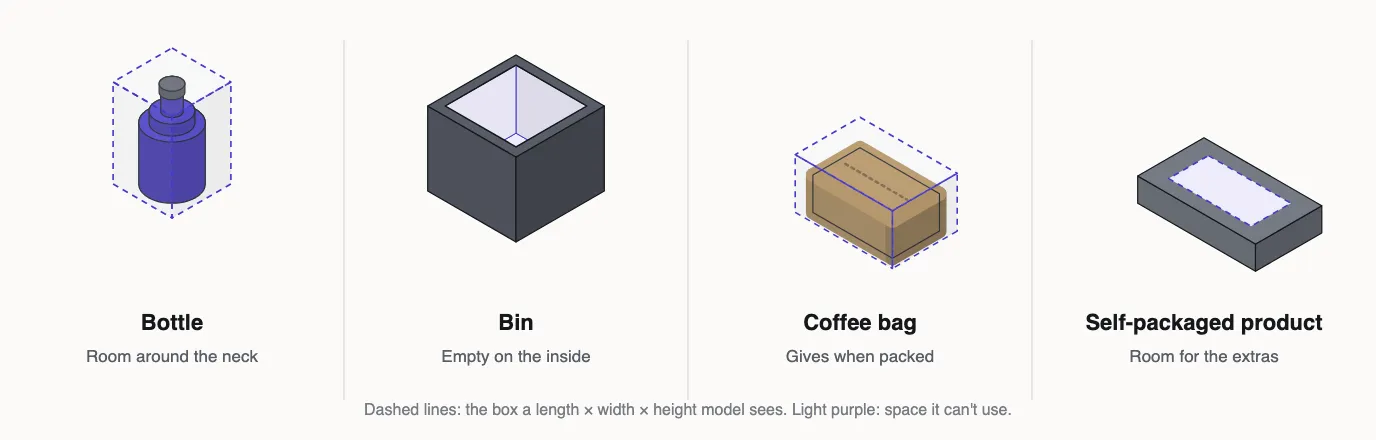
The blocks in that picture never have a bottle neck, and they’re never a bag of coffee.
- Products with empty space. The room around a bottle’s neck or inside a bin can hold other items, but a block model counts it as solid.
- Products that give. A bag of coffee isn’t a box, and it isn’t water either. One roaster I work with ships bags in boxes that, on paper, they don’t fit in.
- Products that ship themselves. Some products go out in their own packaging, with extras stuffed inside.
- Packaging that changes. An insulated liner takes up room in July and not in January.
None of these is rare, and a rectangle can’t describe any of them.
What to do about it
If your products really are boxed, rigid goods, a block model is fine. ShipStation’s Recommend Package rule may be all you need, so try that first.
To find out where you stand, ask your packers which recommended boxes they keep swapping. If it’s the same products every time, those are the ones your software thinks are cubes.
For operations past what rules can do
Your products aren't cubes either?
String's Pro Automation packs your products the way they actually behave, in a box your team can really close.